-(2).jpg?w=300&h=130)

After a broken ankle, pain is often not the only thing that disrupts daily life. Suddenly losing the ability to walk and move normally can make even the simplest tasks much more difficult.
Going to the bathroom, preparing food, carrying a glass of water or coffee, climbing stairs, going to work, shopping, or even moving lightweight items around the house can become activities that require careful planning.
This leads many patients to the same question: What is the best walking aid for a broken ankle?
The straightforward answer is that there is no single “best” mobility aid for everyone with an ankle fracture. The right choice depends on several important factors:
- How much weight your doctor allows you to place on the injured leg
- Your balance
- Your upper-body strength
- Your home environment
- Whether you need to use stairs
- Your normal level of daily activity
- Whether you need to keep your hands free
It is especially important to understand that reduced pain does not mean you can automatically begin putting weight on the injured ankle. Your doctor should determine when and how much weight you can safely place on it based on the type of fracture, its stability, the treatment you received, and your healing progress. Putting weight on the injured ankle before your doctor allows it may interfere with healing and, in some cases, cause the fracture to shift.
If you are looking for the best walking aid for a broken ankle or trying to determine which mobility aid for a broken ankle may suit your needs, this guide compares traditional underarm crutches, forearm crutches, knee scooters, walkers, and hands-free crutches.
For people who need a non-weight-bearing walking aid, we will also look more closely at the options designed to keep the injured foot off the ground.
First, Understand Your Doctor’s Weight-Bearing Instructions
Before choosing a mobility aid, the most important question is not which device feels the most comfortable. It is what weight-bearing status your doctor has prescribed.
Your weight-bearing restrictions determine whether crutches, a walker, a knee scooter, or a hands-free crutch may be appropriate.
The following are three of the most common weight-bearing levels.
Non-Weight Bearing (NWB)
Non-weight bearing means that the injured foot must not support any of your body weight. When standing or moving, the injured side should remain protected and off the ground.
This type of restriction is common during the early stages of recovery after certain ankle fractures or surgeries.
Patients may use mobility aids such as:
- Underarm crutches
- Forearm crutches
- A walker
- A knee scooter
- A suitable hands-free crutch
The appropriate choice should depend on your doctor’s recommendations, your balance, and the environment in which you will use the device rather than personal preference alone.
Partial Weight Bearing (PWB)
Partial weight bearing means that your doctor allows the injured foot to support only part of your body weight.
The exact amount may vary depending on your recovery plan and should be determined by your healthcare provider.
During this stage, patients may use:
- Crutches
- A walker
These devices can help control how much weight is transferred through the injured leg and reduce the risk of overloading it.
As healing progresses, your doctor may gradually increase the amount of weight you are allowed to place on the ankle. Your use of mobility aids may change accordingly.
Weight Bearing as Tolerated (WBAT)
At this stage, your doctor has determined that you can gradually place more weight on the injured leg according to your comfort and tolerance.
Pain and stability may help guide activity, but only after your healthcare provider has specifically approved this level of weight bearing.
Some patients may:
- Wear a walking boot
- Use a single crutch
- Use a cane
- Gradually reduce their dependence on mobility aids
However, you should never move directly from non-weight bearing to full weight bearing on your own.
Progression in weight bearing should be based on your doctor’s clinical assessment and, when appropriate, imaging—not simply on the fact that your ankle “doesn’t hurt anymore.”
What Are the Most Common Walking Aids for a Broken Ankle?
There are five main types of walking aids commonly considered during ankle fracture recovery.
Understanding how each one works, along with its advantages and limitations, can help you make a more informed choice.
1. Traditional Underarm Crutches
Best for:
- Short-term recovery
- Budget-conscious patients
- People instructed to remain completely non-weight bearing
- Users who are comfortable relying on both hands for support
Advantages:
- Relatively affordable
- Widely available from pharmacies and medical supply stores
- Lightweight and easy to transport
- Suitable for a variety of indoor and outdoor environments
- Can be used on stairs with proper technique and experience
Limitations:
- Both hands are usually occupied
- Require considerable upper-body strength
- Prolonged use can cause fatigue in the hands, wrists, arms, and shoulders
- Incorrect technique can cause discomfort and excessive pressure around the underarm area
One of the biggest frustrations with traditional crutches is that even carrying a glass of water from the kitchen to the living room becomes difficult.
You either need to find another way to transport the item or attempt to support yourself and carry something at the same time—which can be impractical and unsafe.
This is one reason some patients eventually begin looking for alternatives that allow them to keep their hands free, such as a hands-free crutch.
2. Forearm Crutches
Best for:
- People already comfortable using crutches
- Patients who need mobility support for a longer period
- Users looking for a more compact design
Forearm crutches, sometimes called elbow crutches or Lofstrand crutches, use a cuff around the forearm combined with a handgrip.
Advantages:
- More compact than traditional underarm crutches
- Good maneuverability
- Easier to store
- Often suitable for longer-term users
- Do not place pressure directly under the armpits
Limitations:
- Still require the use of both hands
- Require arm strength and balance
- Have a learning curve
- First-time users may initially find them less stable than underarm crutches
Forearm crutches are commonly used for longer-term mobility support, but patients recovering from an ankle fracture may still begin with traditional underarm crutches depending on their doctor’s recommendations and personal needs.
3. Knee Scooter
Best for:
- Patients who have been told to remain non-weight bearing
- People who need to travel longer distances
- Office environments
- Shopping malls
- Larger homes
- Users who mainly move across flat surfaces
A knee scooter, also known as a knee walker, is a wheeled mobility aid. The user rests the knee of the injured leg on a padded platform and pushes the device forward using the uninjured leg.
Advantages:
- Does not require you to repeatedly lift your body using your arms
- Often more comfortable for longer distances
- Many models include baskets for carrying personal items
- Can be practical during extended non-weight-bearing recovery
Limitations:
- Bulky compared with crutches
- Requires more storage space
- Less maneuverable in narrow bathrooms or hallways
- Not suitable for stairs
- Requires caution when turning
- Can be more difficult to use on thick carpet, thresholds, gravel, or uneven outdoor surfaces
A knee scooter is not automatically “better than crutches.”
Its biggest advantages appear in certain environments. If you have stairs at home, limited space, or frequently move over uneven surfaces, a knee scooter may not be the most practical option.
4. Walker
Best for:
- People who prioritize stability
- Users with limited balance
- Older adults
- Patients who need additional support during the early stages of recovery
A walker is a frame-style mobility aid that provides a wide base of support. The user grips the handles, moves the walker forward, and then steps or advances while using the frame for stability.
Advantages:
- Wide base of support
- High level of stability
- Useful for short-distance indoor mobility
- Can provide greater confidence for people concerned about falling
Limitations:
- Requires both hands
- Slower than many other mobility aids
- Bulky in narrow areas and doorways
- Not suitable for stairs
- Less practical for active users who frequently go outside
A walker may be particularly useful for people with poor balance. For younger or more active ankle-fracture patients, however, it can feel restrictive or cumbersome.
5. Hands-Free Crutch
Best for:
- Selected patients instructed to remain non-weight bearing
- Adults with good balance
- People with relatively active daily routines
- Users who want to reduce dependence on their hands
- People who find traditional crutches tiring for their wrists and arms
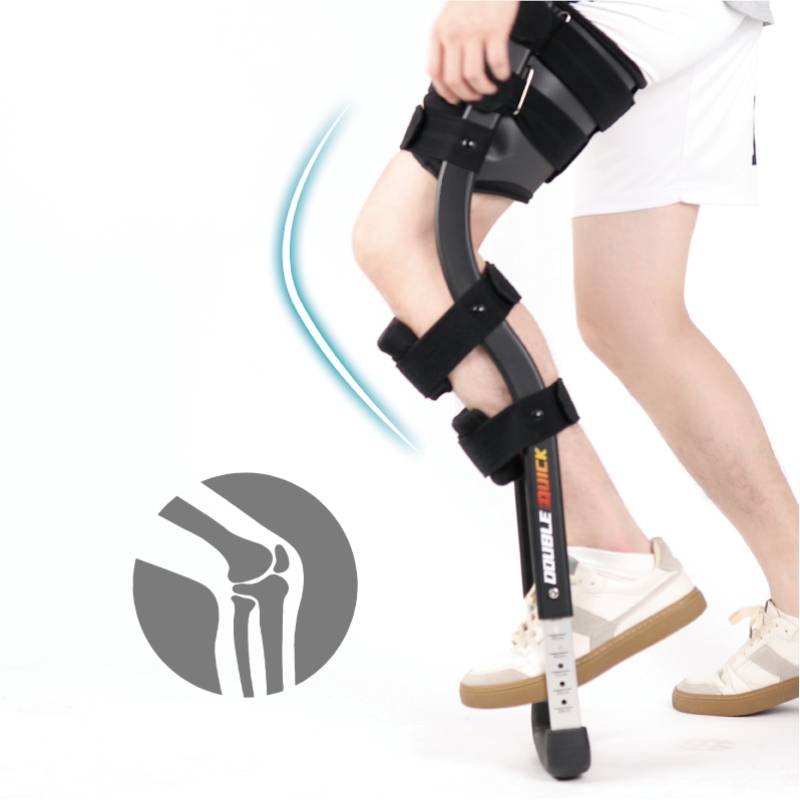
A hands-free crutch is a different type of mobility aid designed to support the injured lower leg while keeping the foot elevated.
The user secures the injured leg to the device and moves using the uninjured leg together with the support structure of the crutch.
Advantages:
- Keeps both hands free
- Keeps the injured foot off the ground
- Reduces the need to support your body through the hands and underarms
- More compact than many knee scooters
- Can make certain work and household tasks easier
Limitations:
- Must be properly adjusted
- Requires practice
- Requires adequate balance and coordination
- Is not suitable for everyone
- Should only be used when compatible with your doctor’s weight-bearing instructions
Hands-free crutches can provide another option for people who want to maintain greater independence during recovery, but they are not appropriate for every patient—particularly those with poor balance or a high risk of falling.
Quick Comparison: Which Walking Aid Is Best for Different Situations?
The table below compares five common mobility aids across several practical factors.
| Comparison | Underarm Crutches | Forearm Crutches | Knee Scooter | Walker | Hands-Free Crutch |
|---|---|---|---|---|---|
| Supports NWB | Yes | Yes | Yes | Yes | Yes, for suitable users |
| Hands-free | No | No | Partly, if equipped with a basket | No | Yes |
| Upper-body demand | High | Medium to high | Low | Medium | Low |
| Indoor use | Good | Good | Moderate; needs space | Good | Good |
| Outdoor use | Good | Good | Moderate; best on flat surfaces | Limited | Moderate |
| Stairs | Possible with proper technique | Possible with proper technique | No | No | Generally not recommended |
| Long-distance mobility | Moderate; can be tiring | Moderate | Good | Limited | Moderate |
| Easy to store | Yes | Yes | No | No | Yes |
| Learning curve | Low | Moderate | Low | Low | Moderate to high |
Based on these characteristics:
- Best budget-friendly option: Traditional crutches. They are affordable, widely available, and work in many environments.
- Best when stability is the priority: A walker. Its wider base of support can be useful for people with limited balance.
- Best for longer distances on flat surfaces: A knee scooter. It can be efficient in offices, malls, and other large, level spaces.
- Best for keeping your hands free: A hands-free crutch. This can be useful for suitable users who need to perform everyday tasks while moving.
There is still no universally “best” device.
The right mobility aid depends on your doctor’s weight-bearing instructions, your physical condition, and your daily environment.
Best Hands-Free Option: DBG Healthcare Hands-Free Crutch
If you and your healthcare provider determine that a hands-free mobility solution is appropriate, one option worth considering is the DBGHealthcare Hands-Free Crutch Telescopic Single-Leg Assisted Walking Aid.
It should not be presented as “the best walking aid for every broken ankle.”
A more accurate position is:
Best Hands-Free Option
Keeps the Injured Foot Off the Ground
The DBG Healthcare Hands-Free Crutch uses a leg-support structure to hold the injured lower leg and foot in an elevated position so the foot does not contact the ground.
Its purpose is straightforward: to help suitable users remain mobile while following prescribed non-weight-bearing restrictions.
For patients with ankle fractures who have been instructed to remain NWB, keeping the injured foot from bearing body weight is an important part of following the treatment plan.
It is equally important to understand what the device does not do.
This product is designed to assist mobility. It does not treat an ankle fracture, accelerate bone healing, shorten recovery time, or stimulate bone growth.
Fracture healing depends on the type of injury, treatment, individual health factors, and adherence to medical instructions. A mobility aid simply helps you move around during recovery.
Keeps Both Hands Free for Everyday Activities
This is one of the main advantages of the DBG hands-free walking aid.
Traditional crutches occupy both hands, which can make everyday activities surprisingly difficult. A hands-free walking aid allows suitable users to keep their hands available while moving.
This may make tasks such as the following more manageable:
- Preparing simple meals: Take ingredients from the refrigerator or work at the kitchen counter without constantly managing crutches.
- Making coffee: Keep your hands available when preparing or carrying a drink.
- Opening doors: Use your hands without first having to position or lean your crutches somewhere.
- Carrying lightweight objects: Handle books, documents, or other small items.
- Working in an office: Keep your hands available for files and other work materials.
- Standing at a workstation: Use a keyboard, mouse, or other tools with both hands.
- Performing light household tasks: Fold clothes or organize a countertop.
- Shopping: Reach for products without having both hands occupied by crutches.
These real-life situations often communicate the practical value of a hands-free mobility aid more clearly than product specifications alone.
For people who need to continue working or maintain a degree of independence during recovery, having both hands available can be a meaningful advantage.
Compatible With Casts and Walking Boots
The DBG Healthcare product is designed to work with several common types of lower-leg immobilization, including:
- Casts
- Walking boots
- Braces
- Splints
This can be particularly relevant for people recovering from ankle or foot injuries, because casts and walking boots are commonly used during recovery.
However, compatibility still depends on several factors:
- Location of the injury: Different fractures may require different positioning and support.
- Type of immobilization: The thickness and shape of a cast or boot may affect fit.
- Your doctor’s treatment requirements: Your healthcare provider may recommend or advise against a particular mobility aid.
- Proper device fit: The straps and support points must work correctly with your immobilization device.
Before purchasing, it is sensible to confirm that your cast, boot, brace, or splint is compatible with the product.
Adjustable Telescopic Design
The DBG Healthcare Hands-Free Crutch includes adjustable components that allow it to accommodate different users.
Adjustments include:
- Thigh fit
- Lower-leg length
- Leg-support positioning
An adjustable design is particularly important with a hands-free crutch because everyone has different leg proportions.
If the device cannot be adjusted correctly, it may feel unstable, distribute pressure poorly, or become uncomfortable.
Measure carefully before purchasing.
Correct sizing and adjustment can have a major impact on comfort, stability, and the overall user experience.
Follow the product instructions when measuring your thigh circumference, lower-leg length, and other relevant dimensions. When possible, have someone assist you when fitting the device for the first time.
Lightweight Aluminum Construction
The DBG Healthcare model uses an aluminum alloy construction and weighs approximately 1.58 kg.
Compared with a full-size knee scooter, a hands-free crutch takes up less space and can be easier to transport or store.
For users who frequently move between home, work, and a vehicle, a more compact design can be a practical advantage.
Another goal of the hands-free design is to reduce continuous reliance on the hands, wrists, arms, and shoulders.
Traditional crutches require the upper body to participate heavily in supporting and moving the body. A hands-free crutch shifts the movement pattern away from constant upper-body support.
However, phrases such as “effortless to use” or “walk just like normal” should be avoided.
A hands-free crutch still requires practice, balance, coordination, and physical effort. Different users will have different experiences depending on their strength, balance, injury, and frequency of use.
Hands-Free Crutch vs. Knee Scooter: Which Is Better for a Broken Ankle?
Hands-free crutches and knee scooters can both be considered by certain non-weight-bearing patients, but they are designed for different environments and priorities.
Consider a Knee Scooter If:
A knee scooter may be more suitable if:
- You spend most of your time on flat, level surfaces
- You regularly travel longer distances
- You work in a large office, school, or similar environment
- You do not need to use stairs frequently
- You have access to elevators
- You prefer rolling rather than using a single-leg walking pattern
- You have enough storage space for the device
The main advantage of a knee scooter is efficient mobility over longer distances on smooth, open surfaces.
Consider a Hands-Free Crutch If:
A hands-free crutch may be worth considering if:
- You want to keep both hands available while moving
- You frequently need to open doors, carry lightweight objects, or use your hands at work
- You spend time in kitchens, offices, or other environments where your hands are frequently needed
- Your home has limited storage space
- You want a more compact mobility aid
- You experience significant upper-body fatigue with traditional crutches
- You have good balance and coordination
- Your doctor considers this type of device appropriate for your recovery
The key advantages of a hands-free crutch are its compact design and the ability to keep both hands available.
Hands-Free Crutch vs. Traditional Crutches
Many people considering a hands-free crutch naturally compare it with the traditional crutches they already know.
There are three major differences to consider.
Upper-Body Demand
When using traditional crutches, your hands, wrists, arms, and shoulders remain actively involved in supporting and moving your body.
Every step requires upper-body effort, which can become tiring during prolonged use.
A hands-free crutch is designed to reduce dependence on the upper body.
The injured leg remains elevated while movement is supported through the device and the uninjured leg, meaning the hands and shoulders are no longer the primary support points.
However, it would be misleading to claim that a hands-free crutch is always easier for everyone.
A person with strong upper-body strength but poor balance may feel safer on traditional crutches. Someone with good balance who experiences significant wrist or shoulder fatigue may prefer a hands-free design.
The best option depends on the individual.
Daily Independence
Traditional crutches have one obvious drawback: both hands are usually occupied.
This often creates a frustrating choice:
Move or carry something—but not both easily.
For example, if you want to walk from the living room to the kitchen and get a glass of water, traditional crutches can make the process surprisingly complicated.
A hands-free crutch is designed to allow suitable users to move while keeping both hands available.
This may make it easier to:
- Carry a lightweight drink
- Open doors
- Handle paperwork
- Use elevator buttons
- Perform simple work tasks
Consider an office worker recovering from ankle surgery who has been instructed to remain non-weight bearing. With traditional crutches, carrying documents while opening office doors can be awkward.
A hands-free device may make these everyday movements more manageable for a suitable user.
Storage and Transportation
Compared with a knee scooter, a hands-free crutch can offer practical storage and transportation advantages:
- Takes up less floor space
- Easier to place in a vehicle
- Easier to store at home
- Does not require a large dedicated storage area
Of course, this may not matter as much if you have plenty of space and primarily use your mobility aid in one location.
For users who regularly move between home, work, and a vehicle, however, the more compact format can be useful.
How to Choose the Right Walking Aid for a Broken Ankle
Choosing a mobility aid should not simply come down to which product looks best.
Several factors need to be considered.
1. Follow Your Doctor’s Weight-Bearing Instructions First
This is the single most important factor.
Before choosing any walking aid, confirm which weight-bearing category applies to you:
- NWB — Non-Weight Bearing: No weight on the injured leg
- TTWB — Toe-Touch Weight Bearing: The toes may lightly touch the floor for balance, with little or no meaningful weight placed through the leg
- PWB — Partial Weight Bearing: A limited amount of weight is allowed
- WBAT — Weight Bearing as Tolerated: Weight can be increased within the limits prescribed by your healthcare provider
Do not choose a device based only on what feels comfortable.
Being able to “put the foot down a little” does not mean your doctor has approved weight bearing.
Your mobility aid needs to match your prescribed recovery stage.
2. Evaluate Your Balance
Balance is especially important when considering a hands-free crutch.
Ask yourself:
- Do I lose my balance easily?
- Have I had previous falls?
- Can I maintain stable single-leg balance?
- How good is my coordination?
- Am I comfortable learning a new movement pattern?
If your balance is limited, a more stable device such as a walker or traditional crutches may be more appropriate.
A hands-free crutch requires users to adapt to a different walking pattern, so balance and coordination matter.
Do not force yourself to use a hands-free device simply because it appears more convenient.
Safety should come first.
3. Consider Your Home Environment
Your home layout can significantly affect which mobility aid works best.
Ask yourself:
- Do you have stairs?
- Do you need to use them every day?
- Are your hallways narrow?
- Can a walker or knee scooter fit through your doorways?
- Do you have thick carpet?
- Is your bathroom small?
- Will you spend much time outdoors?
- Are your floors level?
- Are there thresholds or steps between rooms?
For example, someone living in a multistory home without an elevator may find a knee scooter difficult to use as their only mobility aid.
Someone living in a spacious, single-level home may find one very practical.
4. Consider Your Daily Routine
Different lifestyles create different mobility needs.
Office workers:
You may value keeping your hands free, moving through doorways easily, and being able to perform work tasks while standing. A hands-free crutch may be worth considering.
People spending most of their time at home:
If you only need to move short distances, a walker or traditional crutches may already meet your needs.
People moving through large spaces:
For large offices, schools, or shopping areas, a knee scooter may be more efficient over longer distances.
People who regularly perform simple household tasks:
If you need to prepare food, open doors, or handle lightweight objects, the hands-free design may offer a practical advantage.
5. Check Sizing and Adjustability
Fit is especially important when purchasing a hands-free device.
Check factors such as:
- Thigh circumference
- Lower-leg length
- Height adjustment
- Strap position
- Leg-support adjustment
The adjustable design of the DBG Healthcare product provides some flexibility, but you still need to confirm that your measurements fall within the supported adjustment range.
An incorrectly sized device may cause:
- Instability
- Poor support positioning
- Discomfort
- A more difficult learning experience
Significant sizing problems may also increase safety concerns.
Measure carefully before purchasing and follow the fitting instructions closely.
Who May Benefit Most From a Hands-Free Crutch?
Based on the factors above, a hands-free crutch may be worth considering for:
- Selected patients instructed to remain non-weight bearing
- Adults recovering from certain foot or ankle injuries
- People with good balance
- Users with relatively active daily routines
- People who need to use both hands during work or daily activities
- Users who want an alternative to long-term traditional crutch use
- People using a compatible cast or walking boot
It is important to avoid making the absolute claim that:
“Every person with a broken ankle can use a hands-free crutch.”
This type of mobility aid has a specific use case and is not a universal solution.
Who Should Be More Cautious With a Hands-Free Walking Aid?
This is an important consideration because hands-free crutches are not appropriate for everyone.
People who should be particularly cautious include:
- People with poor balance: A hands-free crutch requires adequate stability during movement.
- People with a history of falls: A more stable mobility aid may be preferable.
- People with poor coordination: Learning a different walking pattern may be difficult.
- People who cannot maintain a stable single-leg stance: A hands-free device may not be appropriate.
- People who do not fit the device correctly: Poor sizing can significantly affect stability and comfort.
- People whose doctor has recommended another mobility aid: Medical advice should take priority over personal preference.
- People whose injury or immobilization method is incompatible with the device: Not every fracture or cast configuration is suitable.
If you are unsure whether a hands-free crutch is appropriate for your ankle injury, consult your orthopedic specialist, doctor, or physical therapist before changing mobility aids.
A professional assessment can help you choose a safer and more appropriate option.
Tips for Moving Safely With a Broken Ankle
No matter which mobility aid you choose, several general safety principles apply.
Follow your weight-bearing restrictions.
Do not begin putting weight on the injured ankle simply because the pain has decreased. Less pain does not necessarily mean that the fracture has fully healed.
Practice before using your mobility aid in more complicated environments.
Start on a flat, clear indoor surface and become comfortable with the device before attempting more demanding situations.
If you are working with a physical therapist, follow their instructions.
Remove trip hazards around your home.
Pay particular attention to:
- Loose rugs
- Electrical cables
- Clutter
- Small furniture
Be careful on wet or slippery surfaces.
Common high-risk areas include:
- Bathrooms
- Kitchens
- Wet outdoor surfaces
Use extra caution on stairs.
Not every mobility aid is designed for stair use. Make sure you understand the correct technique for your device.
Use a handrail or ask for assistance when necessary.
Wear any immobilization device prescribed by your doctor correctly.
This may include:
- A cast
- A walking boot
- A brace
- A splint
A mobility aid does not replace the need for appropriate immobilization.
Stop if the device feels clearly unstable.
Do not force yourself to continue using a mobility aid that feels unsafe.
The device may need to be readjusted, or another type of mobility aid may be more appropriate.
When Can You Stop Using a Walking Aid After a Broken Ankle?
There is no single timeline that applies to every ankle fracture.
How long you need a mobility aid depends on factors such as:
- Location of the fracture: Different fractures follow different recovery patterns.
- Severity of the fracture: A simple stable fracture and a more complex fracture can require very different recovery plans.
- Whether surgery was required: Surgical and nonsurgical treatment may follow different rehabilitation pathways.
- Healing shown on X-rays or other imaging: Imaging can help your doctor assess progress.
- Age: Healing time can vary between individuals and age groups.
- Overall health: Factors such as general health, nutrition, and certain medical conditions may affect recovery.
- Your doctor’s assessment: Your healthcare provider should make the final decision.
A common progression may look like:
Non-Weight Bearing → Partial Weight Bearing → Weight Bearing as Tolerated → Normal Walking
Mobility aids may also change throughout recovery, for example:
Walker / Crutches / Hands-Free Crutch → Two Crutches → One Crutch / Cane → No Walking Aid
This process may take weeks or months depending on the individual injury and recovery plan.
The important point is not to stop using your mobility aid early simply because you want to speed up recovery.
Follow your doctor’s instructions and progress only when it is medically appropriate.
Final Verdict: What Is the Best Walking Aid for a Broken Ankle?
So, what is the best walking aid for a broken ankle?
The answer depends on your prescribed weight-bearing level, your balance, and your daily mobility needs.
There is no single solution for everyone, but each type of device has situations in which it performs particularly well.
Traditional Crutches may be suitable for:
- Budget-conscious patients
- Short-term use
- People who need a portable, widely available option
- Users who may need to manage stairs with proper technique
Walker may be suitable for:
- People who prioritize stability
- Users with limited balance
- Older adults
- Short-distance indoor mobility
Knee Scooter may be suitable for:
- Longer-distance mobility
- Flat indoor surfaces
- People who do not need to use stairs frequently
- Users with adequate storage space
Hands-Free Crutch may be suitable for:
- Appropriate non-weight-bearing users
- People who want to keep both hands free
- Users looking to reduce dependence on traditional crutches
- People with active daily routines who frequently need to use their hands
For people looking for an alternative to traditional crutches and who want to keep both hands available during non-weight-bearing recovery, the DBG Healthcare Hands-Free Crutch Telescopic Single-Leg Assisted Walking Aid is one option worth considering.
Its adjustable design is intended to support the injured lower leg and keep the foot elevated while allowing the user to keep both hands available for work and certain everyday activities.
Most importantly, whichever mobility aid you choose, use it according to your healthcare provider’s guidance and follow your prescribed weight-bearing restrictions.
A walking aid is designed to help you stay safer and more independent during recovery—it is not a substitute for medical treatment or professional rehabilitation advice.